An awning tent is exposed to rain, sun, dirt and daily use. Over time, that leaves marks. The good news is that most problems can be prevented or solved at home, without specialist knowledge. When you know what to look for, your awning tent stays clean, functional and water-repellent for longer.
Why problems with awning tents occur
Most issues are caused by moisture, built-up dirt and a protective layer that has worn away over time. If an awning tent is stored damp or not maintained regularly, stains, leaks and wear appear much faster.
Regular maintenance in the right order makes a real difference here.
The Ultramar 3-step maintenance process
The same basic approach applies to many problems:
- Cleaning – removes loose dirt and general contamination
- Stain removal – targets stubborn, deeply embedded contamination
- Protection – restores water repellency and helps reduce new dirt buildup
Each step has its own purpose. Skipping or combining steps always leads to a weaker end result.
The 11 most common problems
1. Small holes in the fabric
Small holes are usually caused by wear. In many cases, you can repair them easily using repair patches or a liquid repair product. Make sure the fabric is clean and dry before you start.
2. Condensation on the inside
Condensation is difficult to prevent completely. Good ventilation greatly reduces the risk. Keep ventilation openings open, even at night, so moisture can escape.
3. Rust on the frame
Rust forms when moisture stays on the frame for too long. Clean the frame, dry it thoroughly and only store it when it is completely dry.
4. A stiff or damaged zipper
Often the problem is not the zipper itself, but tension in the fabric. Check whether the awning tent is set up correctly and evenly tensioned. In many cases, that already solves the issue.
5. Weather-related stains on the fabric
These stains often appear when an awning tent is packed away while wet. Remove them as soon as possible. A well-protected fabric is much easier to clean and less prone to this type of staining.
6. Creases in the window panels
Creases usually result from incorrect storage or insufficient tension. When the awning tent is pitched correctly, many creases will smooth out on their own. Completely preventing them is not always possible.
7. Side panels are not tight
Check whether all poles are properly tensioned and the pegs are positioned correctly. An uneven surface can also cause this problem.
8. Side panels do not reach the ground
This can happen if the caravan is positioned too high or the setup is not well balanced. Choosing a more level surface often helps.
9. Leaks
Leaks usually occur when the water-repellent properties of the fabric have worn off. Restoring protection helps rain bead off the fabric again.
10. Green or dark deposits on the fabric
These marks develop after long exposure to moisture and dirt. Regular cleaning prevents them from becoming embedded in the fabric.
11. Dirt that won’t come off
If the fabric still looks dirty after normal cleaning, the contamination is often deeply embedded. This requires targeted stain removal before you apply protection again.
What you need for proper maintenance
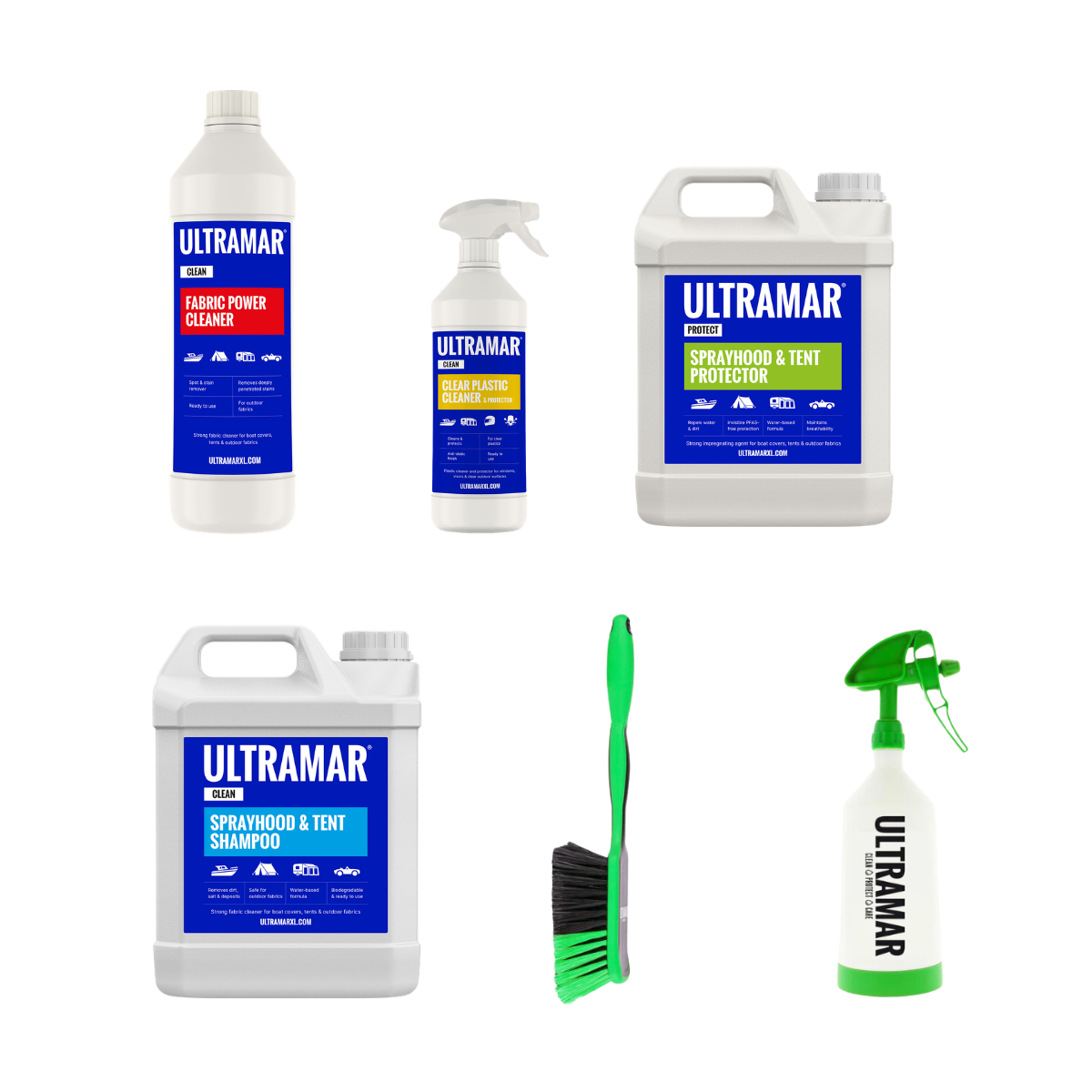
For reliable results, it is best to follow the fixed Ultramar system:
- Sprayhood & Tent Shampoo – for thorough cleaning
- Power Cleaner – for stubborn, deeply embedded contamination
- Sprayhood & Tent Protector – to protect synthetic awning tent fabrics
Ultramar also offers maintenance bundles that combine these products. This is often more cost-effective and ensures you have everything you need for complete maintenance.
Do not be too economical with product use. Even coverage requires enough product, and having a little extra is useful for future maintenance or small touch-ups.
Practical tips
- Store your awning tent as dry as possible
- Do not use household cleaners on outdoor fabrics
- Never use a pressure washer on fabric
- Only apply protection when the fabric is clean and completely dry
Summary
Most awning tent problems are easy to manage. With regular maintenance, the right order of steps and suitable products, your awning tent stays clean, water-repellent and in good condition for longer.
Ultramar
Ultramar helps consumers clean, maintain and protect awning tents, boat covers and other outdoor fabrics themselves. Using PFAS-free maintenance products that are easy to use at home and based on a proven three-step maintenance process.