Leaking seams in your tent or boat cover are frustrating. Often the fabric itself is still in good condition, but water gets in through the stitching. The good news: in many cases you can fix this yourself, easily at home.
Why are seams a weak point?
Seams are where two pieces of fabric are stitched together. During stitching, small needle holes are created. Over time, these can start letting water through.
This usually happens because of:
- Wear of the fabric around the seam
- Ageing seam tape on synthetic fabrics
- Stitching thread that no longer seals well, especially after frequent use
With cotton or canvas fabrics, seams sometimes only become fully waterproof once the fabric gets wet. The thread swells slightly and closes the needle holes.
What really works to make seams waterproof?
Treating seams separately with thick seam sealers may sound logical, but often causes visible streaks and uneven results. You also only protect the seam itself, not the surrounding fabric.
The most reliable approach is to restore water repellency to the entire fabric. This way, the seams are protected as part of the whole surface.
The Ultramar 3-step maintenance process
Ultramar always works in a fixed order. This is essential for a durable and consistent result.
Step 1 – Cleaning
Always start with a clean fabric. Dirt prevents protection from bonding properly.
Use a suitable cleaner for outdoor fabrics, such as Ultramar Sprayhood & Tent Shampoo.
Step 2 – Stain removal (only if needed)
If you still see stubborn discoloration or heavily soiled areas after cleaning, treat those spots specifically with a stain remover.
This step is meant for deeply embedded contamination, not for the entire surface.
Step 3 – Protection
Once the fabric is clean and completely dry, apply protection.
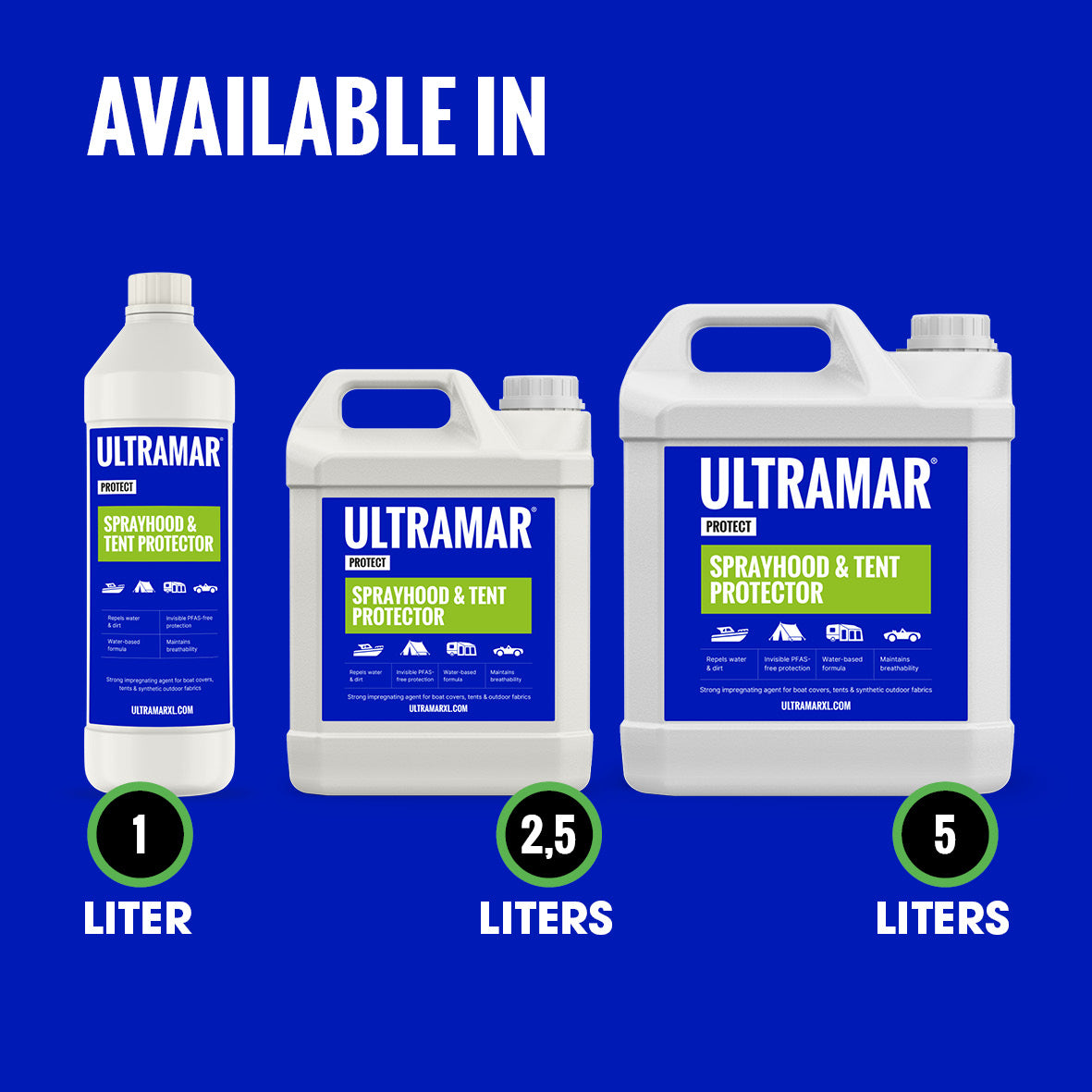
For synthetic tents, boat covers and awnings, use Ultramar Sprayhood & Tent Protector. This restores the water-repellent properties of both the fabric and the seams.
By treating the whole fabric, you prevent water from collecting around the seams.
Practical tips for the best result
- Always apply protection to dry fabric
- Work evenly and use enough product
- Treat seams carefully, without applying thick layers
- Check the stitching beforehand: if the thread is badly worn, maintenance alone may not be enough
- Remove product immediately from plastic windows; they are not fabric
What do you need?
In most situations, this combination works best:
- Ultramar Sprayhood & Tent Shampoo
- Ultramar Sprayhood & Tent Protector
If there is visible, stubborn contamination, add Ultramar Power Cleaner as an extra step.
Ultramar also offers maintenance bundles. These combine the correct products and are often more cost-effective than buying items separately.
Do not be too economical with product use. Using too little can lead to uneven results and may cause seams to leak again sooner. Choosing a slightly larger container is often more practical for even coverage and future maintenance.
Frequently asked questions
Do I need to seal seams separately?
In most cases, no. When you properly protect the entire fabric, the seams are automatically included. This gives a cleaner and longer-lasting result.
Does this also work for boat covers and awnings?
Yes. The same principle applies to tents, boat covers, convertible roofs and other synthetic outdoor fabrics.
Is this suitable for home use?
Yes. Ultramar maintenance products are PFAS-free, easy to use and designed for application at home, without specialist knowledge.
In summary
Leaking seams do not mean your tent or boat cover needs to be replaced. In many cases, you can solve the problem yourself by properly cleaning and protecting the fabric.
With Ultramar’s proven 3-step maintenance process, both the fabric and the seams become water-repellent again and last longer.
Ultramar
Ultramar helps you clean, maintain and protect tents, boat covers, convertible roofs, awnings and other outdoor fabrics yourself. Using PFAS-free maintenance products that are easy to apply at home and based on a proven three-step maintenance process.