Removing green deposits from your boat cover: common mistakes and the right approach
Green deposits on your boat cover are one of the most common forms of contamination in outdoor textiles. Especially when your boat sits outside for extended periods — in shade, under trees, or in a damp berth — green discoloration gradually builds up. And while it looks unsightly, it can be removed effectively in most cases. Provided you approach it the right way.
In this article, you'll learn about common mistakes people make when removing green deposits, why these mistakes make the problem worse, and how to do it properly in three steps — yourself, at home, without professional expertise.
Why do green deposits form on a boat cover?
Green deposits form primarily in areas where moisture lingers for long periods. Think of:
- Covers that rarely dry out due to shade or poor weather
- Boat covers that are stored or folded while wet
- Textiles without adequate protection against moisture accumulation
- Berths under trees or in enclosed environments with poor air circulation
The problem isn't just cosmetic. Green deposits can damage the textile over time. The contamination slowly penetrates deeper into the fibers. The longer you wait, the more difficult it becomes to remove completely.
Common mistakes when removing green deposits
Many boat owners tackle green deposits in ways that do more harm than good. These are the most common mistakes:
Mistake 1: Using a pressure washer
This seems quick and effective — but the powerful water jet damages the fiber structure of the textile. You literally blast away the protective layer. Afterward, moisture penetrates faster and green deposits often return even sooner.
Mistake 2: Household cleaning products or green deposit cleaners from hardware stores
Many of these products are developed for stone, wood, or plastic — not for textiles. They can damage fibers, cause discoloration, or destroy the water-repellent properties of your cover. Moreover, they often contain aggressive substances unsuitable for outdoor textiles.
Mistake 3: Only brushing without cleaning
Dry brushing removes visible dirt from the surface but not the deeper penetrated discoloration. The result: within a few weeks, the green deposits are back just as badly.
Mistake 4: Forgetting to protect after cleaning
This is perhaps the biggest mistake. If you clean the cover but don't protect it again, the textile becomes more vulnerable than before. Moisture penetrates faster, dirt adheres more easily, and green deposits return accelerated.
Mistake 5: Treating on wet or damp fabric
Protection products don't adhere well to damp textiles. Those who waterproof immediately after cleaning without letting the fabric dry completely waste product — and time.
Want to learn more about common mistakes in boat cover maintenance? You'll find comprehensive information there about what you should avoid.
The right approach: the Ultramar 3-step plan
Green deposits on a boat cover are best removed in three separate steps. Each step has its own function. Don't skip any, and don't combine them into one action.
Step 1: Cleaning — Sprayhood & Tent Shampoo
Start by cleaning the entire surface. This removes loose dirt, dust, and the top layer of contamination. Use Ultramar Sprayhood & Tent Shampoo for this. This product is specifically developed for outdoor textiles and doesn't damage the fiber structure.
How:
- Wet the cover with lukewarm water
- Apply the shampoo and work it in with a soft brush
- Let it work briefly
- Rinse thoroughly with clean water
Tip: Work preferably in shade. Direct sunlight causes the product to dry too quickly, making it less effective.
Step 2: Stain removal — Power Cleaner
After cleaning, you'll often see that part of the green discoloration is still visible. This is because the contamination has penetrated deeper into the fibers. Here you use Ultramar Power Cleaner — a stain remover for stubborn, deeply penetrated contamination.
How:
- Apply Power Cleaner to visible stains
- Let it work according to package instructions
- Heavy discoloration may require a second treatment
- Rinse the textile thoroughly afterward
Tip: Test first on a small, inconspicuous piece of textile. This way you check how the material reacts — especially with older covers or unknown fabrics.
Step 3: Protection — Sprayhood & Tent Protector
Once the cover is completely clean and dry, apply a protective layer. This makes the textile water-repellent again and ensures dirt and moisture adhere less easily. Use Ultramar Sprayhood & Tent Protector for this.
For cotton or canvas covers, Ultramar Cotton Canvas Protector is more suitable — it's tailored to the properties of natural fibers.
How:
- Ensure the textile is completely dry
- Apply the product evenly — don't be too sparing
- Let it dry for at least 24 hours before folding the cover or letting it get wet
Important: Don't be too sparing with the protection product. A layer that's too thin gives uneven coverage. Better to use slightly more than the minimum, so the entire surface is well protected.
How do you recognize when maintenance is needed?
You don't have to wait until green deposits are clearly visible. Watch for these signals:
- Water no longer beads off but penetrates the fabric
- The textile feels damp after rain and dries slowly
- You see slight discoloration in areas that stay wet for long periods
- The cover smells musty after unfolding
The earlier you intervene, the less intensive the treatment needs to be. With light contamination, sometimes only steps 1 and 3 are sufficient.
Differences by material type
Not every boat cover reacts the same to green deposits or cleaning. The material partly determines which approach works best:
- Acrylic (like Sunbrella): Tolerates cleaning well. Dries relatively quickly. Use Sprayhood & Tent Protector after cleaning.
- Cotton or canvas: Absorbs moisture faster and is more sensitive to deep discoloration. Use Cotton Canvas Protector here. Allow extra drying time.
- Polyester with coating: Check that the coating isn't damaged. When in doubt, test first on a small piece.
Check what material your cover is before starting. This is often on a label inside, or in your boat cover documentation.
What do you need?
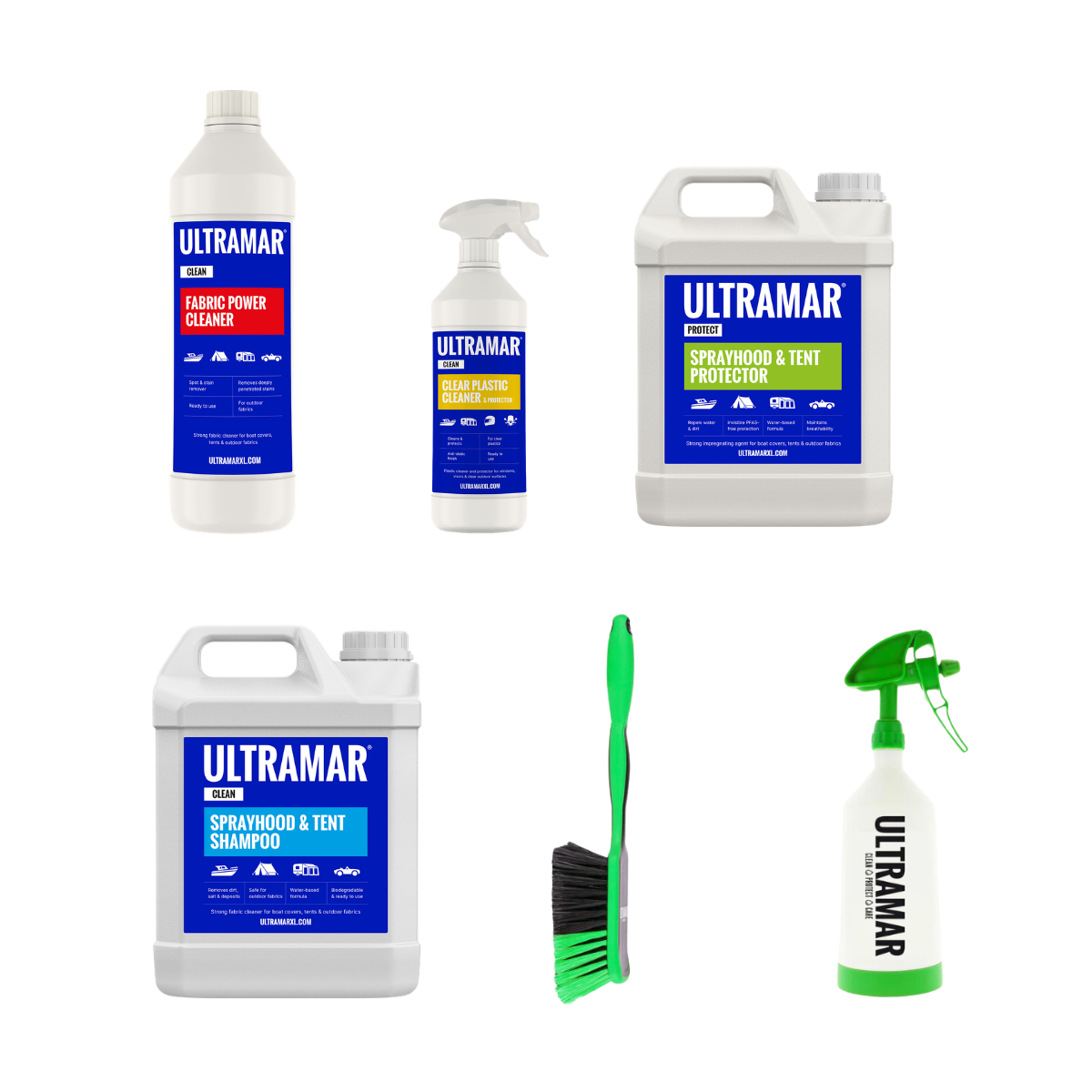
For complete treatment of green deposits on a boat cover, you need three products:
- Ultramar Sprayhood & Tent Shampoo — for cleaning
- Ultramar Power Cleaner — for stubborn green stains
- Ultramar Sprayhood & Tent Protector (or Cotton Canvas Protector for cotton) — for protection
Ultramar offers maintenance bundles combining these products. This is often more economical than individual purchases. Preferably choose a slightly larger package than the absolute minimum. This way you have enough product for even treatment and keep some for future touch-ups of small spots.
Frequently asked questions
How often should I treat my boat cover against green deposits?
This depends on your berth, climate, and how often the cover gets wet. In many cases, complete treatment once or twice a year is sufficient. Is your boat in a sheltered, damp location? Then an additional interim treatment may be worthwhile.
Can I do only step 3 if the cover still looks good?
Protection alone without cleaning first doesn't work well. You then seal dirt under the protective layer. Do at least step 1 (cleaning) before protecting.
Does this work on plastic windows in the cover too?
No, plastic windows require a different product. Ultramar has specific products for plastic windows. Use Sprayhood & Tent Shampoo and Protector only on the textile parts.
Green deposits keep coming back. What am I doing wrong?
You're probably skipping step 3. Without a protective layer, the textile is open and vulnerable. Moisture and dirt then adhere faster. Make sure you protect again after every cleaning. Additionally, it helps to store the cover dry when possible and ensure ventilation.
Are Ultramar products PFAS-free?
Yes. Ultramar maintenance products are PFAS-free. They are therefore safer for people, pets, and the environment — and perfectly suitable for home use.
Summary
Green deposits on your boat cover are annoying, but in most cases can be removed effectively if you follow the right steps. Avoid pressure washing, household products, and half treatments. Work in three steps: clean, remove stains, protect. Use products developed for outdoor textiles. And protect the textile after every cleaning — that makes the biggest difference for the long term.