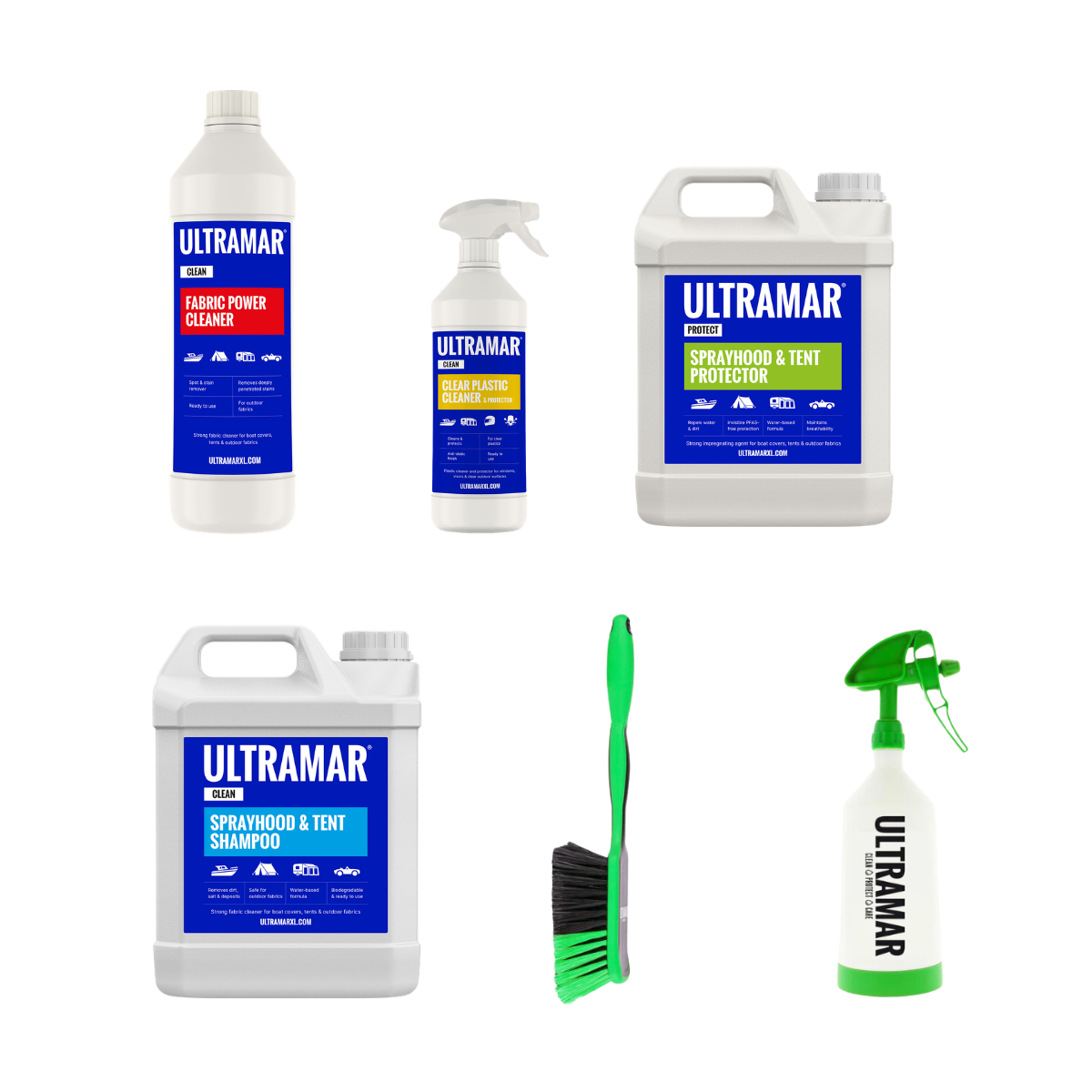
Removing stains from a boat cover: bird droppings, black stains and rain streaks
Bird droppings, black stains and rain streaks are an inevitable part of life for boat covers left outside. In most cases you can tackle them yourself without damaging the fabric. The right approach depends on the type of stain: surface dirt often disappears with a thorough clean, while deeply ingrained stains require targeted stain treatment.
How do you identify which type of stain you're dealing with?
Not every stain on a boat cover is the same. Each type calls for a slightly different approach.
- Bird droppings dry quickly and become hard and white or grey. Fresh droppings are much easier to remove than dried ones. On synthetic fabric, dried bird droppings can locally damage the water-repellent layer if left for too long.
- Black stains are dark, sometimes spotted areas of discolouration. They can develop when moisture and organic dirt remain on the fabric for extended periods. They work their way deep into the fabric structure and won't disappear with rinsing alone.
- Rain streaks are grey or brown lines that run along the folds or seams of your boat cover. They form when dirt and minerals carried by rain or dew travel with the water and dry on the fabric.
What causes these stains?
Boat covers are exposed to rain, wind, sun and birds. Dirt that lands on the fabric is carried along by rain, then dries in lines or patches. Seams and folds are typical collection points where dirt builds up. Bird droppings contain organic substances that quickly penetrate the fabric if not removed promptly. Black stains develop when damp dirt sits on the fabric for a long time, often in spots where water tends to pool.
How do you remove bird droppings from a boat cover without causing damage?
Start by soaking the droppings with lukewarm water to loosen them. Never scrub dried droppings: you'll push the dirt deeper into the weave or damage the fabric structure. Let the water soak in for a moment — after that, scraping is no longer necessary.
Then wash the entire surface with Sprayhood & Tent Shampoo. Dilute the shampoo as directed on the packaging, apply it and work it in gently with a soft brush. Rinse thoroughly with clean water.
If a discoloured patch remains after washing, the stain has penetrated deeper. In that case, apply Fabric Power Cleaner directly to the affected area. Leave it to soak for at least 15 minutes — longer for stubborn stains. Then rinse thoroughly. Fabric Power Cleaner is designed for deeply ingrained stains and should be applied in a targeted way: do not spread it over the entire fabric.
How do you remove stubborn black stains from boat cover fabric?
Black stains sit deep in the fabric structure and often don't respond to regular cleaning alone. Start by washing the fabric with Sprayhood & Tent Shampoo to clean the surface. Rinse well and let the cover drain for a moment.
Then check whether the black mark has faded. If not, targeted treatment with Fabric Power Cleaner is the next step. Apply the product only to the stained area. Leave it for at least 15 minutes — longer is fine. Then work the area gently with a soft brush and rinse thoroughly.
Repeat the treatment if the stain is still visible after drying. Some deeply ingrained black stains only respond fully after a second application.
What are rain streaks on a boat cover and how do you remove them?
Rain streaks are the grey or brown lines that run along the seams and folds of your boat cover. They form when dirt and minerals from rainwater are carried along the fabric and dry in place. They're not harmful to the material, but they look untidy and become harder to remove over time.
Rain streaks generally respond well to Sprayhood & Tent Shampoo. Wash the entire cover — not just the streaks. Cleaning only the streaks can leave new tide marks at the edges where the washed and unwashed areas meet.
For stubborn, dark rain streaks that remain after washing, apply Fabric Power Cleaner directly to the streak. Allow it to soak in, then rinse thoroughly with clean water.
What should you avoid?
- Don't use bleach or harsh household cleaning products. These damage the fabric structure and break down the water-repellent layer.
- Don't use a pressure washer at close range. A pressure washer can damage the fabric structure and pull seams apart.
- Don't scrub dried bird droppings or black stains. Always soak the stain first before applying any friction.
- Never spread Fabric Power Cleaner over the entire fabric. It is a stain remover for targeted use, not a general-purpose cleaner.
- Don't clean in direct sunlight or on hot fabric. Cleaning products dry too quickly under these conditions and can leave marks.
What is the correct order of steps?
The steps always follow the same logic: clean first, then treat. Always start by washing the cover with Sprayhood & Tent Shampoo. Once washed, assess whether any stains remain. Only then should you apply Fabric Power Cleaner to the areas that need it. Don't skip the cleaning step: treating a dirty cover with a stain remover is less effective because surface dirt gets in the way.
When does your boat cover need a protective treatment after cleaning?
After removing stains and thoroughly cleaning your boat cover, the water repellency may have reduced. You'll notice this when water no longer beads up and runs off the fabric, but soaks in instead. In that case, a protective treatment is the logical next step. Stain removal and cleaning are the first steps; protection is the third. That step falls outside the scope of this article, but is well worth doing once the fabric is clean.
FAQ: removing stains from a boat cover
Can I just rinse bird droppings off with water?
Fresh droppings can sometimes be rinsed away with water alone. For dried droppings, soak them first with lukewarm water and then wash with Sprayhood & Tent Shampoo. If a discoloured patch remains, Fabric Power Cleaner will help.
How long should I leave Fabric Power Cleaner to soak in?
At least 15 minutes. For stubborn stains, longer is fine. Don't let the product dry out on the fabric — keep the area slightly damp if needed.
Should I wash the entire cover or just the stain?
It's best to always wash the entire cover, or at least the full panel where the stain is located. This prevents tide marks and colour differences at the boundary between washed and unwashed fabric.
Does Fabric Power Cleaner work on all boat cover materials?
Fabric Power Cleaner is suitable for synthetic outdoor textiles such as polyester and acrylic. If in doubt, test it on a hidden area of fabric first.
What if the stain is still visible after two treatments?
Some stains are so deeply set that they won't disappear entirely. In that case, you can repeat the treatment once the fabric has dried completely. If the stain still won't budge, it may be a permanent change to the fabric itself.