“Water-repellent” sounds simple. But in practice, almost everyone expects something different from it. Some people think water will always stay on top as neat droplets. Others expect everything to remain completely dry, even during heavy rain. And some assume that water-repellent also means “stain-proof” or “maintenance-free”.
When you understand what water-repellent really means — and what it does not — you make better choices. And you avoid disappointment with your boat cover, tent, awning or convertible roof.
Water-repellent means: water beads off (for a while)
A water-repellent fabric does not let water soak into the fibres straight away. Instead, droplets form on the surface and roll off. That is exactly what you want: the fabric stays dry for longer, and dirt usually sticks less easily.
One important thing to know: water-repellent is not an on/off switch. It is a property that can weaken over time, depending on use, weather and exposure.
Water-repellent is not the same as waterproof
This is one of the most common misunderstandings. Waterproof means water cannot pass through at all. Water-repellent means water is slowed down and pushed away, but with enough time, pressure or heavy rain, moisture can still get through.
For many outdoor fabrics, this is perfectly normal. They often need to remain flexible and breathable. A boat cover or tent fabric is designed to protect against rain, not to act like a rigid, sealed layer.
Why does it sometimes seem to “stop working”?
In many cases, the water-repellent effect is not actually gone — it is blocked or disturbed. Common causes include:
- A dirt film on the fabric – even a thin layer of dirt can stop water from beading properly.
- Wear from sun and weather – outdoor fabrics are constantly exposed, especially in sunny areas.
- Friction and folding – seams, edges and fold lines wear faster.
- Residue from unsuitable cleaners – some products leave a film that interferes with water repellency.
This is why a fabric can suddenly look “soaked”, even though it still offers some protection. A proper clean often reveals how good the base condition really is.
A common mistake: protecting a fabric that isn’t clean
Applying protection over dirt locks that dirt in place. The result is often uneven, and the protection usually lasts for a shorter time. Some areas bead water, others absorb it.
This is why maintenance works best in clear steps. Clean first, then protect. If there are stubborn areas, treat those separately in between.
Water-repellent does not mean stain-proof
Protection helps slow down new contamination, because dirt sticks less easily. But it is not a guarantee that stains can never form. Dark discolouration from outdoor use or deeply embedded stains may still need targeted stain removal.
How can you tell if your fabric is still water-repellent?
You do not need specialist knowledge. A simple test is enough:
- Sprinkle a small amount of water on a clean area of the fabric.
- Good: droplets stay on the surface and roll off.
- Borderline: the water forms a flat patch and slowly soaks in.
- Poor: the water soaks in quickly and the fabric darkens immediately.
Important: always test on a clean surface. On a dirty fabric, even good protection can appear to fail.
Why “protection” is a separate step
Cleaning removes dirt. It usually does not restore water repellency to its original level. That is why protection is a separate step: it restores the water-repellent property and helps keep the fabric in good condition for longer.
With Ultramar, this follows a clear three-step maintenance logic:
- 1. Cleaning – remove general dirt and contamination.
- 2. Stain Removal – only where needed: treat deeply embedded and stubborn discolouration.
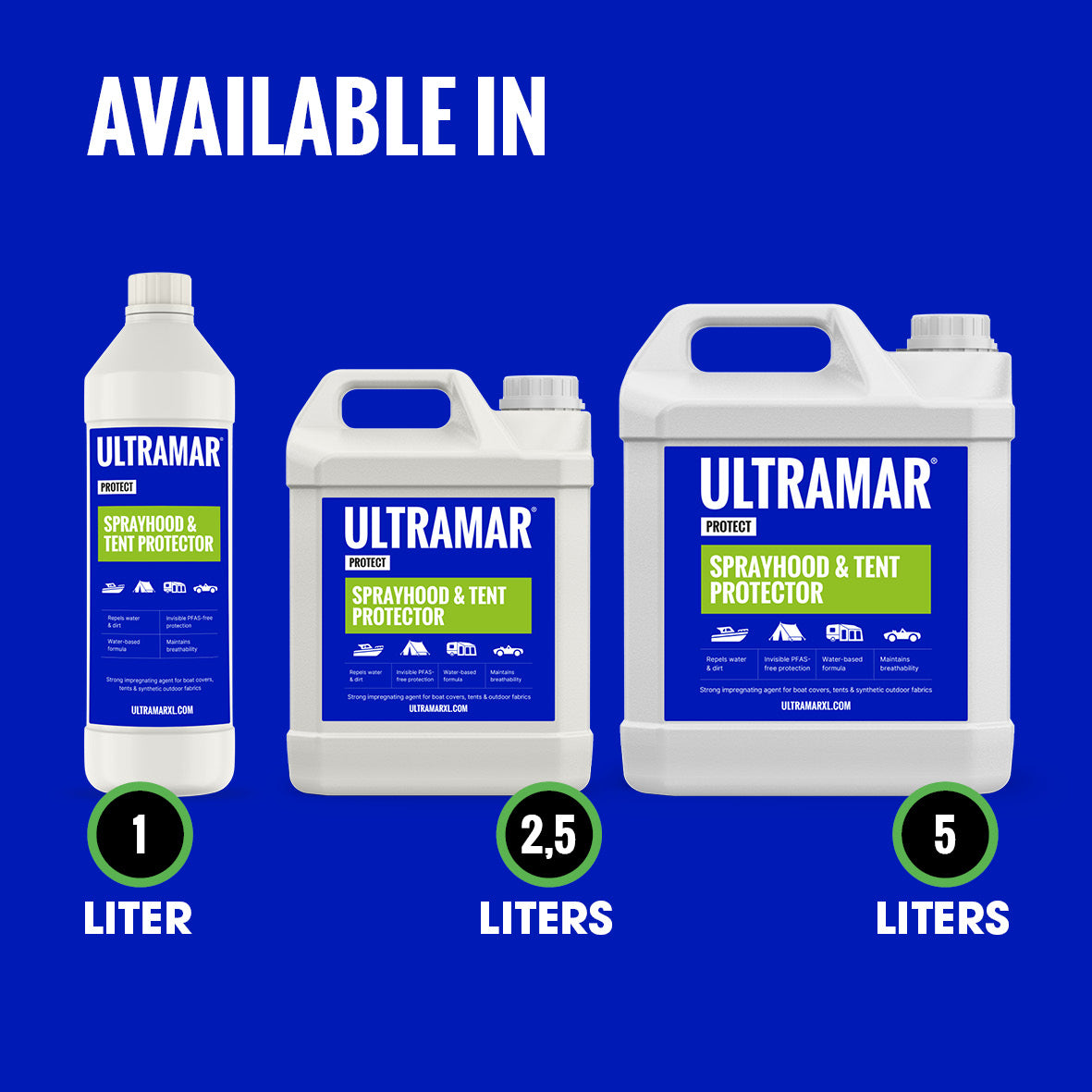
- 3. Protection – restore water repellency and help reduce future dirt build-up.
Not all materials are the same. Synthetic fabrics need a different approach than cotton or canvas. Clear plastic windows are a separate category altogether and should not be treated with fabric protection products.
PFAS-free: what does that say about water repellency?
You will increasingly see “PFAS-free” on maintenance products. This means they do not contain persistent substances that can remain in the environment for a long time. Ultramar maintenance products are PFAS-free and designed for safe use at home — for you, your pets and the environment.
PFAS-free does not mean less effective. It means the product fits normal use around the home, garden, campsite or marina.
What does this mean for you?
- Do not expect water-repellent to mean waterproof. It helps rain bead off and keeps fabrics dry for longer.
- Judge water repellency only on a clean surface. Dirt can hide the real effect.
- Protection works best after cleaning. Clean first, then restore water repellency.
- Choose products that match your material. Synthetic fabrics, cotton/canvas and plastic windows all need different care.
If you want your fabric to look good again and reliably repel water, a clear three-step approach helps: clean, treat stains where needed, and then protect with a PFAS-free maintenance product that suits your material.