You often only notice it when you really start paying attention. Your boat cover looks “pretty fine” at first glance, until you wipe it with a wet hand. Or until the sun hits it at an angle and you suddenly see dull patches, streaks or a grey haze. Many boat owners think: “It’s outside all the time, some dirt is normal.” That’s true. But what you don’t see is exactly what builds up the fastest.
It starts with invisible dirt
A boat cover is made to handle a lot. Wind, rain, sun, spray. That’s precisely why it acts like a net for everything floating through the air. Not just visible sand or dust, but also fine particles you barely notice.
At first, this layer is thin. You mainly feel it rather than see it: the fabric no longer feels really “fresh”, and water stays on the surface just a bit longer. If you wait too long, that layer becomes harder and harder to remove.
Why boat covers “pick up” dirt so quickly
- Shape and construction: Seams, folds, edges and tension points give dirt more places to settle than on flat surfaces.
- Spray and residue: Water splashing up from the deck or hull carries dirt and leaves it behind on the fabric.
- Warm–cold changes: Warm days and cooler nights create damp moments when dirt can attach more easily.
- “Just rinsing it off” helps less than you think: Water removes loose dirt, but often leaves a thin film you only notice later.
The biggest misconception: “If it still looks good, it is good”
This is the common trap. A boat cover can look fine from a distance while the fabric is already losing its water-repellent properties. You usually notice that only when it matters: during heavy rain, with splashing water, or when you pull the cover tight again and it feels stiffer than before.
The problem is not that a cover gets dirty. The problem is that dirt builds up. And the longer it stays there, the more work it becomes to get the fabric back in good condition.
Why “going at it too hard” often backfires
Once a boat cover looks visibly dirty, it’s tempting to want fast results. Scrubbing hard. Rubbing forcefully. Or “just cleaning it thoroughly”. With outdoor fabric, the goal is different: you want it clean, but without putting unnecessary strain on the material.
This is about maintenance, not a battle. A boat cover lasts longer when you remove dirt in time and then restore the water-repellent performance.
Boat covers need care in three separate steps
Many people look for one product to do everything. That sounds convenient, but it rarely works well for outdoor fabrics. Maintenance works best when it is split into three clear steps, because each step has its own purpose:
- 1. Cleaning: removes the general dirt that settles across the entire fabric.
- 2. Stain removal: targets areas with deeply embedded contamination, stubborn discoloration or difficult buildup that normal cleaning does not remove.
- 3. Protection: restores the water-repellent performance and helps prevent new dirt from sticking as quickly.
If you skip steps, you often end up with a “half result”. For example, protecting a fabric that is not truly clean yet. That means you are, in a way, sealing the problem in. Or you clean thoroughly but forget to restore protection, so the cover becomes dirty again much faster.
Where Ultramar fits in logically
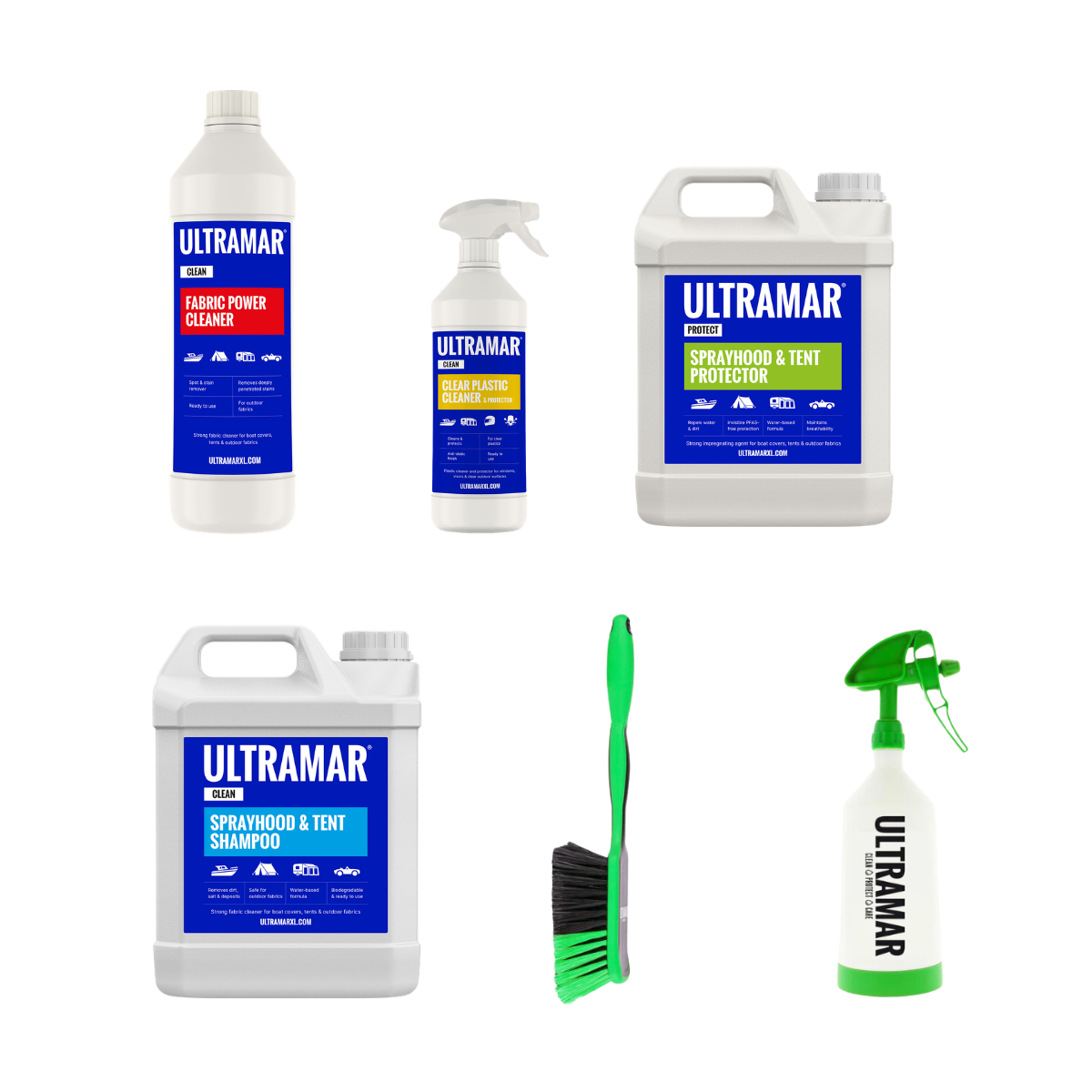
Ultramar is made for consumers who want to do this kind of maintenance themselves. At home, without special tools or specialist knowledge. The products are designed for outdoor fabrics such as boat covers, tents, convertible roofs and awnings.
Ultramar follows a clear maintenance logic: clean first, remove stains where needed, and only then protect. Ultramar maintenance products are PFAS-free. That makes them a sensible choice for use around the home, in the garden, at the campsite or in the marina.
Common mistakes you can easily avoid
- Waiting too long: The longer dirt stays on the fabric, the deeper it settles and the harder it becomes to remove.
- Protecting a fabric that isn’t clean yet: Protection is not a cleaning step.
- Trying to fix everything at once: General dirt and stubborn areas do not need the same approach.
- Forgetting the material: Synthetic fabrics and natural fabrics each need the right type of protection.
What does this mean for you?
Don’t see your boat cover as something that only needs attention when it looks obviously dirty. With a small, logical maintenance routine, it stays clean for longer. By cleaning in time, you prevent dirt from building up. And by restoring protection afterwards, the fabric remains water-repellent for longer and gets dirty less quickly.