Salt water and your boat cover: why rinsing regularly with fresh water matters
Do you sail on salt water? After every trip, invisible salt crystals are left behind on your boat cover. These crystals do more than you might think. They attract moisture, keep the fabric wetter for longer, and gradually attack both the material and the water-repellent coating. Rinsing regularly with fresh water is one of the simplest ways to keep your cover in good condition.
What does salt water actually do to your boat cover?
When seawater splashes onto your boat cover and dries, it leaves behind a thin layer of salt. You won't notice it immediately, but the effects are real:
- Salt attracts moisture. Even on dry days, salt absorbs moisture from the air. This keeps your cover wetter than necessary.
- A damp cover gets dirty faster. Dust, soot, and other contaminants cling more easily to a wet surface.
- Salt residue can damage the water-repellent coating. With prolonged exposure, the protective properties of your cover diminish.
- White stains and discolouration. Dried salt leaves visible deposits, especially on dark fabrics.
The longer salt stays on the fabric, the greater the risk of visible damage and loss of water repellency. This applies to both synthetic textiles and natural materials such as cotton or canvas.
How often should you rinse?
There's no fixed rule that applies to everyone. It depends on how often you sail, how much salt lands on the cover, and how long the boat is left outside. A few guidelines:
- After every trip at sea: a quick rinse with fresh water is most effective. It doesn't take long.
- At least every two weeks: if your boat sits in salt water but you can't rinse after every outing.
- Before long-term storage: rinse the cover thoroughly before winterising your boat or storing the cover.
Don't use a pressure washer. A regular garden hose with a gentle stream is enough. Too much pressure can damage the fibres and disturb the water-repellent coating.
Rinsing alone isn't enough: the Ultramar 3-step plan
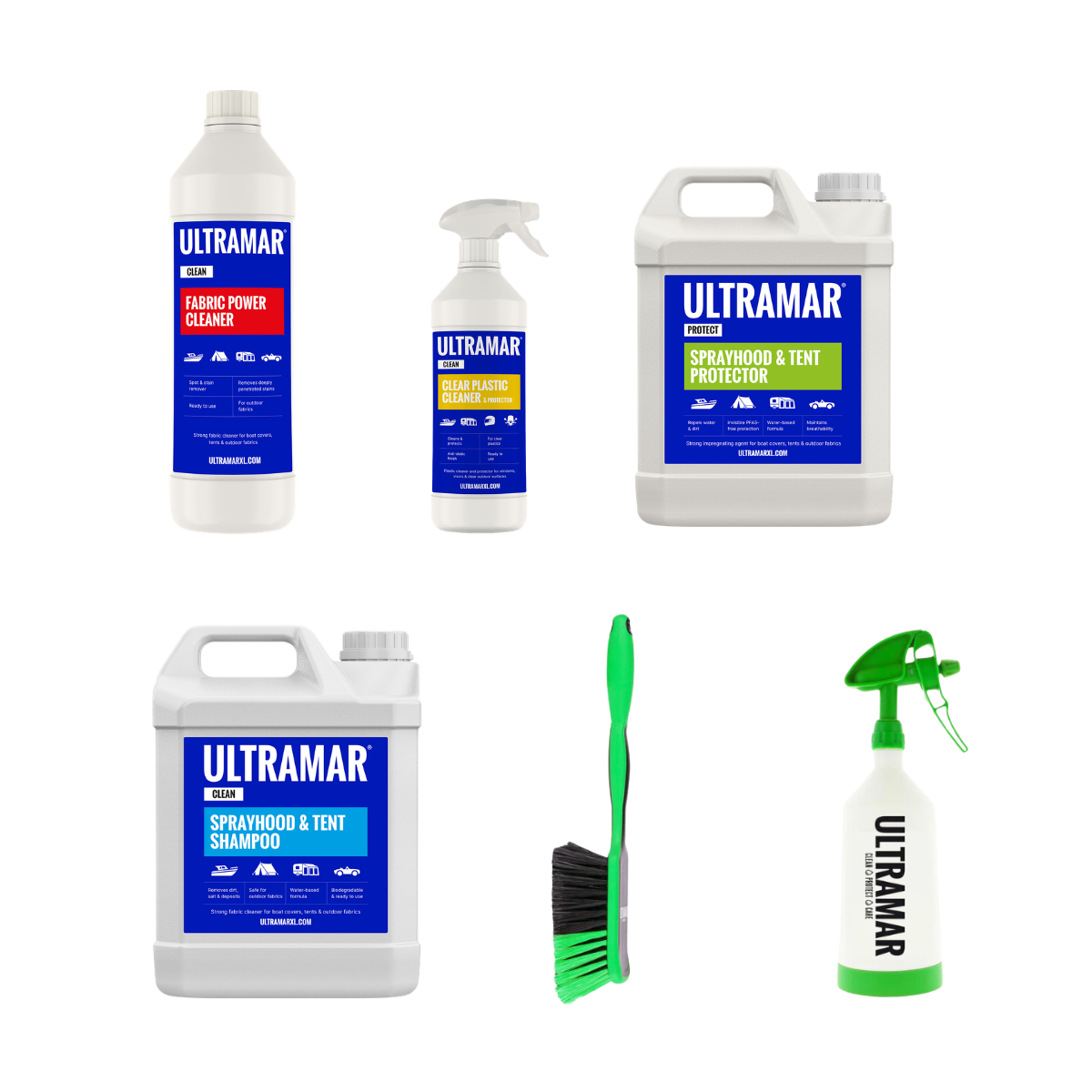
Rinsing regularly with fresh water is good basic prevention, but it's no substitute for periodic maintenance. Salt, grease, and fine particles build up in the fibres and won't be fully removed by water alone. Maintain your cover thoroughly a few times each season with the Ultramar 3-step plan:
Step 1: Clean
Start with a thorough clean to remove built-up dirt, salt residue, and greasy deposits. Sprayhood & Tent Shampoo is designed for exactly this. It cleans the fabric without unnecessarily damaging the fibres or the existing protective coating. Apply the shampoo to a damp fabric, work it in with a soft brush, and rinse thoroughly with fresh water.
Tip: clean in the shade where possible. Direct sunlight can cause the product to dry too quickly, resulting in an uneven finish.
Step 2: Remove stains (optional)
Still seeing stubborn stains or deep discolouration after cleaning? Treat specific areas with Power Cleaner. This product is designed for deeply embedded dirt that shampoo alone can't remove - think dark stains from prolonged soiling or ingrained grease residue.
Use Power Cleaner only where needed, and test on a small, inconspicuous area first. Not all fabrics react the same way.
Step 3: Protect
Once clean and fully dry, apply a protective coating. For synthetic boat covers, use Sprayhood & Tent Protector. For cotton or canvas covers, Canvas & Cotton Protector is the right choice.
The protector restores water repellency and helps prevent dirt and salt from adhering to the fabric as quickly. This makes your next rinse more effective too.
Important: only apply the protector once the fabric is completely dry. On a damp surface, the product won't adhere properly and you'll end up with uneven protection.
Common mistakes with boat covers on salt water
A few mistakes we see time and again. Also read our article on 7 mistakes that damage your boat cover faster for a complete overview.
- Rolling up the cover while it still has salt on it. Salt crystals abrade against the fibres when the cover moves, speeding up wear.
- Only rinsing the top. Salt also splashes onto the inside and along the seams. Rinse the entire surface.
- Assuming rain does the job. Rain washes away some of the salt, but not all of it. Salt tends to remain in seams and folds.
- Using a pressure washer. This damages fibres and pushes dirt deeper into the fabric.
- Using household cleaning products. Many all-purpose cleaners contain substances that break down the water-repellent coating. Always use a product specifically developed for outdoor textiles.
How do you know your cover needs maintenance?
Watch for these signs:
- Water no longer beads off but soaks into the fabric
- White or grey deposits on the surface
- The cover feels stiff or dry
- Stains that don't disappear after rinsing
- The fabric dries noticeably more slowly than before
Seeing one or more of these signs? It's time for a full maintenance session using the 3-step plan.
What products do you need?
For a complete maintenance session on a salt-water boat cover, you'll need:
- Sprayhood & Tent Shampoo (cleaning)
- Power Cleaner (only for stubborn stains)
- Sprayhood & Tent Protector (protection, for synthetic fabric) or Canvas & Cotton Protector (for cotton or canvas)
Ultramar offers boat cover maintenance bundles that combine these products. This is often better value than buying separately, and you have everything to hand straight away.
Choose a slightly larger size than the absolute minimum for your cover surface area. Running out of product halfway through is awkward. A little extra comes in handy for touching up areas that need extra attention, or for a mid-season maintenance session later on.
Differences between material types
Not every boat cover responds to salt in the same way. Check what material your cover is made from:
- Acrylic (such as Sunbrella): relatively resistant to salt, but salt residue can still attack the coating with prolonged exposure. Use Sprayhood & Tent Protector after cleaning.
- Cotton or canvas: absorbs moisture more readily and is therefore more sensitive to the effects of salt. Rinse more frequently and protect with Canvas & Cotton Protector.
- Vinyl or plastic (windows and panels): salt can cause scratches here if you wipe dry. Rinse with water first before cleaning the surface.
Frequently asked questions
Can I rinse my boat cover while it's still on the boat?
Yes, absolutely. Use a garden hose or a bucket of fresh water. Make sure you cover the entire surface, including seams and edges.
How often should I reapply the protector?
It depends on how intensively you sail and how often the cover is exposed to salt, sun, and rain. In most cases, twice a season is enough. Notice that water isn't beading off nicely anymore? Then it's time.
Is rinsing with fresh water really enough as an interim measure?
As a quick interim measure, yes. It removes most of the salt from the surface. But it's no substitute for a thorough clean with shampoo, since fine dirt and grease residue accumulate in the fibres.
Can I store the cover damp after rinsing?
Better not to. Let the fabric dry as much as possible before rolling or folding it. A cover stored damp can develop odours and discolour more quickly.
Summary
Salt water is one of the biggest threats to your boat cover. The solution is straightforward: rinse regularly with fresh water and maintain your cover a few times each season with the right products. The Ultramar 3-step plan (clean, remove stains, protect) keeps your cover water-repellent, looking after itself, and lasting longer. All products are PFAS-free, making them safer for you, your pets, and the environment.