Mould weather on your boat cover: what it is and how to tackle it
Warm, humid weather without wind - in the water sports world, this is called mould weather. These are exactly the conditions that put the most strain on your boat cover. Moisture lingers, heat builds up, and ventilation is absent. The result? Stubborn dark stains and discolouration that penetrate ever deeper into the fabric. In this article, you'll learn how these stains form, how to tackle them, and how to prevent them in future.
What exactly is mould weather?
Mould weather is an informal term for a combination of high humidity, heat, and still air. Think of sweltering summer days, misty autumn mornings, or periods when your boat has been covered for a long time without air circulation.
Under a boat cover or sprayhood, these conditions create a kind of micro-climate. Moisture condenses against the fabric, doesn't dry out, and slowly penetrates deeper into the fibres. This causes stubborn stains, dark discolouration, and an unpleasant smell - especially in places where the fabric is folded or doubled.
How do you recognise the problem?
- Dark or grey-green stains, often on seams and folds
- Discolouration that doesn't disappear with just water and a brush
- A musty smell when you put on or unfold the cover
- Spots that quickly return after cleaning
This type of discolouration usually isn't just on the surface. The contamination has often penetrated deep into the fibres - making it difficult to remove with regular cleaning.
Why just scrubbing isn't enough
A common mistake is to scrub the fabric hard with a stiff brush or a pressure washer. This damages the fibres and affects the water-repellent layer, while the deep discolouration often doesn't disappear. You'll see the fabric look temporarily better, but the stains come back - sometimes faster than before.
The Ultramar 3-step process has been specially developed to tackle these stubborn problems thoroughly, without damaging the material.
The Ultramar 3-step plan for damaged fabric
Step 1: Cleaning with Sprayhood & Tent Shampoo
Start with a thorough clean of the entire surface. The Sprayhood & Tent Shampoo removes dirt, grease, and surface contamination without damaging the fabric. Apply the product to dry or slightly damp fabric. Use a soft brush and work in circular movements.
Tip: Clean in the shade if possible. Direct sunlight dries the product too quickly, which can affect the result.
Step 2: Removing stains with Power Cleaner
After cleaning, tackle the deeply embedded stains. Power Cleaner is a stain remover specially developed for stubborn discolouration in outdoor fabrics. The product penetrates deep into the fibres and dissolves contamination that regular cleaning can't remove.
Apply Power Cleaner undiluted to the affected areas. Leave the product to soak in - the soaking time depends on how deep the contamination is. With heavy discolouration, a second treatment may be necessary.
Important: Test the product first on a small, inconspicuous piece of fabric. Check that the material responds well before treating larger areas.
Note: Power Cleaner is a separate step. Do not combine it with the shampoo, and only apply it after cleaning is fully complete and the fabric is dry.
Step 3: Protecting with Sprayhood & Tent Protector
After cleaning and removing stains, the original protective layer of your boat cover has often (partially) disappeared. Therefore, apply a new water-repellent layer with the Sprayhood & Tent Protector. This product restores water repellency and helps prevent moisture from penetrating deep into the fibres again.
Important: The fabric must be completely dry before applying the Protector. Moisture in the fibres prevents good adhesion.
Note on material type: Do you have a boat cover made of cotton or canvas? Then use the Canvas & Cotton Protector instead of the Sprayhood & Tent Protector.
Common mistakes when dealing with stubborn stains
- Using too little product. Especially with deep discolouration, Power Cleaner must be able to soak in sufficiently. Don't be too sparing - a too-thin layer won't reach the deeper contamination.
- Skipping step 3. After cleaning and stain removal, your fabric is clean, but also unprotected. Without a new protective layer, the fabric is more vulnerable to the same conditions.
- Treating on wet fabric. Moisture in the fabric dilutes the product and reduces results. Always allow to dry completely between steps.
- Using a pressure washer. This damages the fibre structure and can remove the coating. Always use a soft brush or low-pressure spray.
Read more about boat cover maintenance mistakes: 7 mistakes that damage your boat cover faster.
How do you prevent stains from returning?
Completely preventing them is difficult - especially in a humid climate. But you can significantly reduce the risk:
- Ensure ventilation under the cover, especially when covering for extended periods
- Don't store your boat cover while it's wet
- Repeat the protective treatment (step 3) at least once per season, or more often with intensive use
- Regularly check seams and folds - that's where discolouration often starts first
Do you spot early stains in time? Then one treatment with Power Cleaner is usually sufficient. If you wait too long, the discolouration may have penetrated so deeply that multiple treatments are needed - or the fabric may be permanently discoloured.
What do you need?
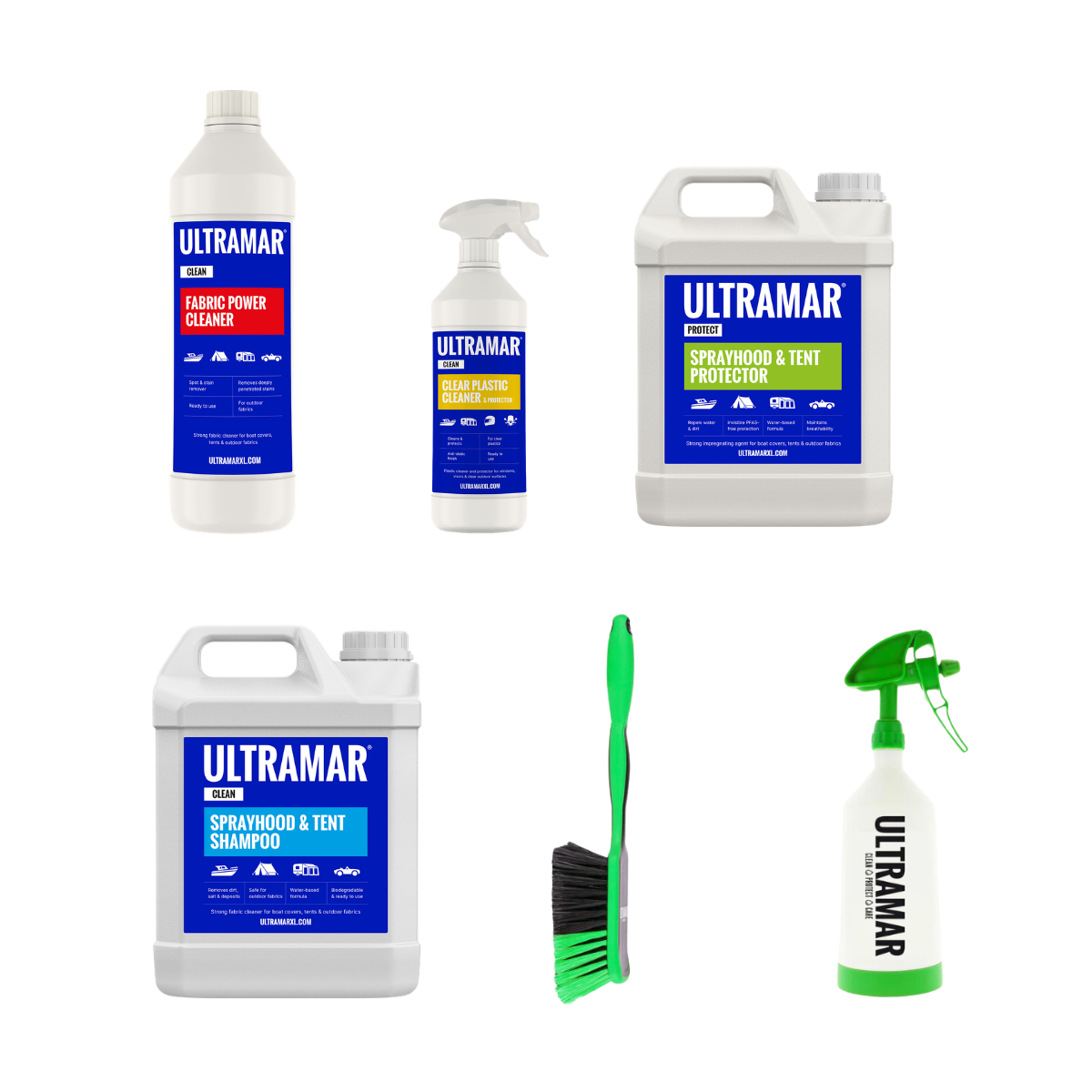
For a complete treatment of a boat cover with stubborn discolouration, you need all three products:
- Sprayhood & Tent Shampoo (cleaning)
- Power Cleaner (stain removal)
- Sprayhood & Tent Protector or Canvas & Cotton Protector (protection)
Ultramar offers maintenance bundles that combine these products, often at a price advantage compared to buying separately. Choose a slightly larger size than the strict minimum. Running out mid-treatment is impractical, and extra product is useful for touching up small areas or future seasonal maintenance.
Frequently asked questions
Can I use Power Cleaner on any type of boat cover?
Power Cleaner is suitable for most synthetic outdoor fabric types such as acrylic and polyester. With cotton or canvas, extra care is needed - always test first on an inconspicuous area. Check the material type before you begin.
How often should I renew the protective layer?
That depends on use, storage, and weather conditions. As a rule of thumb: at least once per season. Notice that water no longer beads off nicely? Then it's time for a new treatment.
What if stains return after treatment?
Returning stains often indicate a deeper moisture problem. Check that there is adequate ventilation and that the fabric is stored dry. Repeat step 2 if necessary, and make sure step 3 is properly applied for lasting protection.
Can I skip step 2 if the stains aren't too bad?
For light surface stains, the shampoo (step 1) may sometimes be sufficient. If the discolouration doesn't fully disappear after cleaning, Power Cleaner is needed to tackle the deeper contamination.
Ultramar: designed for home use
Ultramar products are designed so you can maintain your boat cover yourself, without specialist knowledge or professional equipment. The 3-step process is easy to follow and in many cases delivers a result where you see a difference straight away.
All Ultramar maintenance products are PFAS-free: safer for you, your pets, and the environment, without compromising on effectiveness.