Why you should not clean tent fabric with washing-up liquid or green soap
Washing-up liquid and green soap seem like convenient solutions for cleaning your tent. They are cheap, you have them at home, and they clean everything, right? Yet in most cases these products are not suitable for tent fabric. They can damage the water-repellent layer and actually make the fabric more vulnerable to moisture and dirt.
What happens when you use washing-up liquid or green soap on tent fabric
Washing-up liquid is designed to dissolve grease. It does that well on plates and pans, but on tent fabric that same property works against you. The water-repellent treatment on your tent fabric consists of a thin protective layer that keeps water beading rather than soaking in. Washing-up liquid can break down or partially remove that layer.
Green soap has a similar effect. It is a powerful degreasing agent that works well on hard surfaces, but on textiles it can reduce the protective properties of the fabric.
These are common consequences of using household cleaning products on tent fabric:
- Water repellency decreases, causing the fabric to absorb moisture more quickly
- Soap residue remains in the fibres and actually attracts new dirt
- The fabric can dry unevenly because the protective layer is damaged in patches
- Cotton or canvas tents can wear more quickly
Why tent fabric is different from a worktop or a floor
Tent fabric is treated to perform under changing weather conditions. Whether it is acrylic, polyester or cotton: most tent fabrics have a water-repellent or waterproof finish. That finish is specifically applied to protect the material against rain, dew and condensation.
Household cleaning products do not take this into account. They are made to dissolve grease and dirt, regardless of what lies beneath. On tent fabric that also dissolves the protective layer. The result: a tent that looks clean but gets soaked much faster in the next downpour.
This also varies by material. Cotton and canvas tents are often more sensitive than synthetic fabrics. But even with polyester and acrylic, the treatment can be damaged by the wrong cleaning products.
How to clean tent fabric correctly
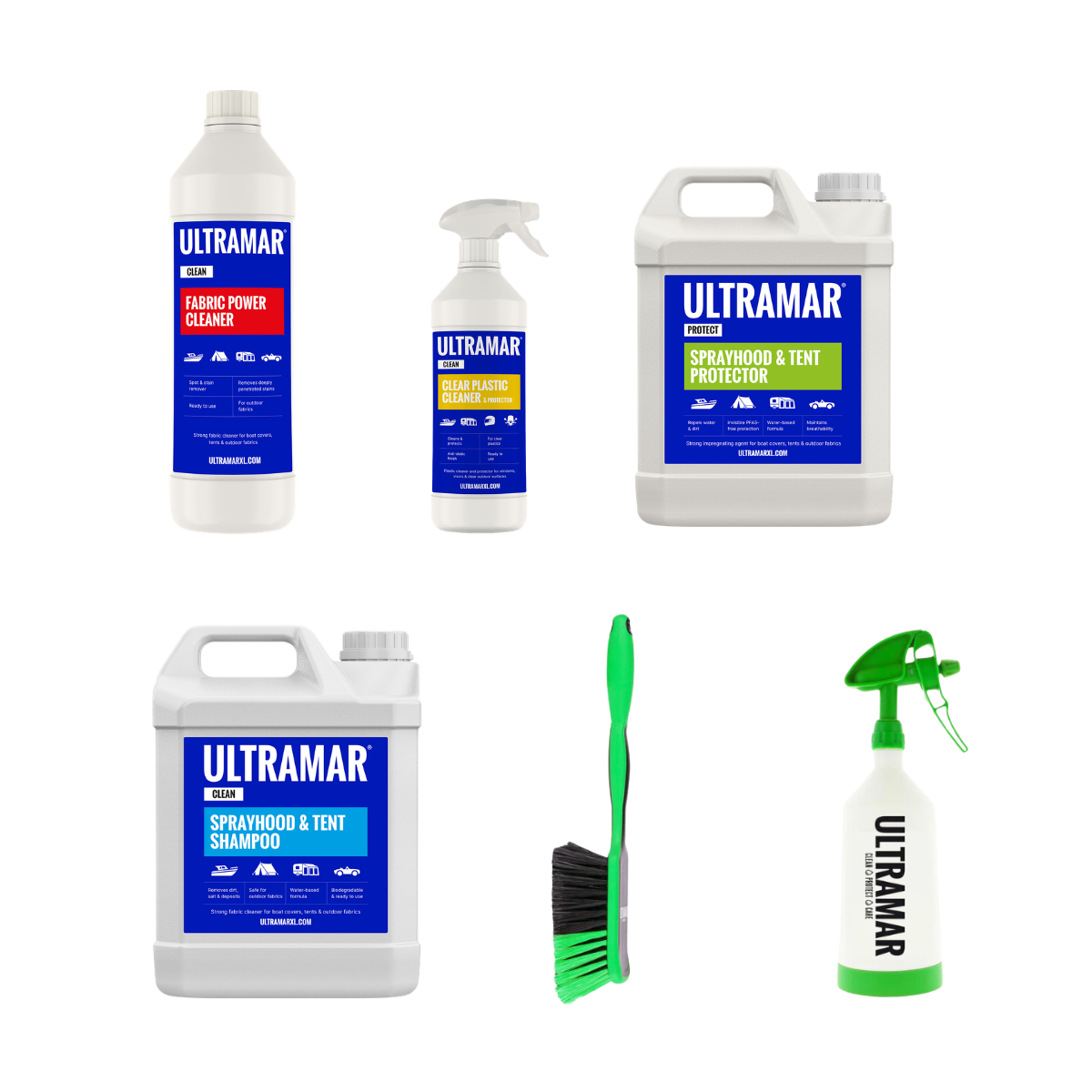
Ultramar uses a clear three-step process developed specifically for outdoor textiles such as tent fabric. Each step has its own function and its own product.
Step 1: Clean with Sprayhood & Tent Shampoo
The Ultramar Sprayhood & Tent Shampoo is developed to remove dirt, deposits and light contamination without damaging the water-repellent layer. Unlike washing-up liquid or green soap, this shampoo is pH-neutral and formulated for the properties of outdoor textiles. Apply it with a soft brush or sponge, leave it to work briefly, and rinse off with water.
Step 2: Remove stubborn stains with Fabric Power Cleaner
Are there still deeply embedded stains or stubborn discolouration visible after cleaning? Then you can use the Ultramar Fabric Power Cleaner as a stain remover. Apply it directly to the affected area and leave it to work. Rinse thoroughly afterwards. This step is only needed when regular cleaning does not give sufficient results.
Step 3: Protect with the right protector
After cleaning it is wise to restore the water-repellent properties. Do this with the Ultramar Sprayhood & Tent Protector (for synthetic fabric) or the Canvas & Cotton Protector (for cotton and canvas tents). Apply the protector to completely dry, clean fabric. After drying, a water-repellent layer forms that helps repel rain and dirt.
Note: for cotton tents, always use the Canvas & Cotton Protector. It is specifically formulated for natural fibres and respects the breathable character of cotton.
Practical tips for cleaning tent fabric
- Clean your tent in the shade if possible. Direct sunlight can cause cleaning products to dry too quickly and leave marks.
- Let the fabric dry completely before applying a protector. Moisture trapped under the protective layer can cause problems.
- Test a new product on a small, inconspicuous area first to see how the material reacts.
- Do not use a pressure washer on tent fabric. The force can damage the weave and the protective layer.
- Only store your tent when it is dry. Storing it damp increases the risk of unpleasant odours and discolouration.
How do you recognise that your tent fabric needs maintenance?
A few signs that it is time for cleaning and protection:
- Water no longer beads off but soaks into the fabric
- The fabric feels dirty or sticky
- There are visible stains or discolouration on the surface
- After rain, the tent fabric takes noticeably longer to dry than before
How often maintenance is needed depends on how intensively you use the tent, how you store it, and what weather conditions the fabric is exposed to. With intensive use, it is wise to go through the full three-step process at least once per season.
What do you need?
For a complete maintenance session for your tent fabric, you need the following products:
- Sprayhood & Tent Shampoo for cleaning
- Fabric Power Cleaner for stubborn stains (if needed)
- Sprayhood & Tent Protector or Canvas & Cotton Protector for protection
Ultramar offers maintenance bundles that combine these products. This is often more cost-effective than buying separately and ensures you have everything to hand. Choose a slightly larger pack than the minimum, so you can apply generously for an even result and have product left for touch-ups or a future maintenance session.
Frequently asked questions
Can I not just rinse my tent with water?
Water alone removes loose dirt such as sand and dust. But embedded contamination, deposits or greasy stains usually cannot be removed that way. For those you need a cleaner specifically suitable for outdoor textiles.
Is green soap not mild enough for tent fabric?
Green soap is often considered mild, but it is a degreasing agent. That degreasing action can damage the water-repellent treatment of tent fabric. For outdoor textiles it is therefore not the best choice.
Do I need to re-impregnate after every clean?
In most cases it is wise to renew the protective layer after a thorough clean. Cleaning often removes part of the water-repellent treatment, even when using the correct product. By applying a protector after cleaning, you restore that protection.
What if I have already used washing-up liquid on my tent?
Rinse the fabric thoroughly with clean water. Let it dry completely and check whether water still beads off. If water repellency has decreased, you can treat the fabric again with the right protector to restore protection.
Summary
Washing-up liquid and green soap are not developed for outdoor textiles. They can reduce the water-repellent properties of tent fabric and make the material more vulnerable to moisture and contamination. Use a cleaner specifically formulated for tent fabric instead, such as Ultramar Sprayhood & Tent Shampoo. Combine this with the right protector to restore water repellency and keep the fabric in good condition for longer.
Ultramar develops maintenance products for outdoor textiles, suitable for home use. PFAS-free and safe for people, pets and the environment.